Wednesday, March 26, 2014

The Baumquadrat (Tree Cube) is a small room in the trees that can be used for relaxing, sleeping and playing. Depending on the size and stability of the trees in your backyard, the structure can stand on stilts or be suspended in the trees. The cube measures 2.30 x 2.50 x 2.50 meters with 80mm thick walls, and the interior and exterior façade is paneled with larch wood.
Baumraum recommends that the Baumquadrat be installed about 3 meters above ground, and it can be assembled out of several modules. The ladder rails are made of galvanized steel with larch rungs, while the roof is topped with sheet metal.
Read More >>
Related Posts:

Regardless of creed, ethnicity, or tax bracket, everyone must breathe the same air. This week, the World Health Organization announced that air pollution was responsible for seven million deaths globally in 2012. It is also the single largest preventable health risk worldwide. Both indoor and outdoor particulate matter is to blame for illnesses such as stroke, heart disease, respiratory infections, lung cancer, and chronic obstructive pulmonary disease. Not just harmful to human bodies directly, much of the pollution also contributes to the acceleration of climate change and its catastrophic affect on agriculture, the economy, and biosphere.
According to the WHO, air pollution is responsible for one death in eight every year. Overall, 4.3 million deaths worldwide were linked in 2012 to indoor pollution primarily due to cooking with coal, dung, or wood stoves. Outdoor pollution from diesel engines and fires were linked to 3.7 million deaths. Many populations are exposed to poor air quality in both settings, causing a degree of overlap within the aggregate figure of seven million deaths. Further chronic health risks such as birth defects and impaired cognitive abilities in children add to the already sobering statistics.
Read More >>
Related Posts:
Sunday, March 16, 2014

In a permanent extension of a 2007 law, San Francisco has made it illegal for the City to buy or distribute plastic water bottles. Bottled water contributes to massive amounts of litter and plastic waste all over the world. San Francisco has an aggressive plan to achieve zero net waste by 2020. In late 2013, Inhabitat reported that San Francisco’s Board of Supervisors appeared ready to enact one of the strictest bans on bottled water in the nation. Days ago, the proposal became law, and plastic water bottles smaller than 21 ounces will no longer be allowed on city property starting Oct. 1, 2014.
As Inhabitat’s Charley Cameron reported last year, San Francisco’s legislation, introduced by Supervisor David Chiu, “does not prohibit private business from trading in small plastic bottles of water.” Rather, it restricts the sale at events of more than 100 people (not including marathons and other sporting events), and on all city property and parks. San Francisco Airport will also be allowed to sell plastic bottles indefinitely.
Related: More Than 90 College Campuses Ban The Sale of Bottled Water
San Francisco’s Board of Supervisors supported the legislation unanimously. Prior to the vote, Chiu held up a water bottle that was a quarter of the way filled with oil. The move illustrated just how much oil is used in the production and transport of plastic water bottles.
“He also reminded San Franciscans that the current fad of buying bottled water only started in the 1990s when the bottled water industry mounted a huge ad campaign that got Americans buying bottled water,” reports the San Francisco Bay Guardian. “Somehow, Chiu noted, ‘for centuries, everybody managed to stay hydrated.’ He, and the rest of San Francisco seem confident that they can learn to do so again.
Not surprisingly, the American Beverage Association and bottled water industry were less than enthusiastic about the bottled water ban. These critics claim that banning bottled water at concerts and other large events will drive them to choose alcohol or carbonated beverages instead of healthier water.
Via San Francisco Bay Guardian
Related: Concord, Mass. Becomes First U.S. City To Ban Single-Use Plastic Water Bottles
Read More >>
Saturday, March 15, 2014
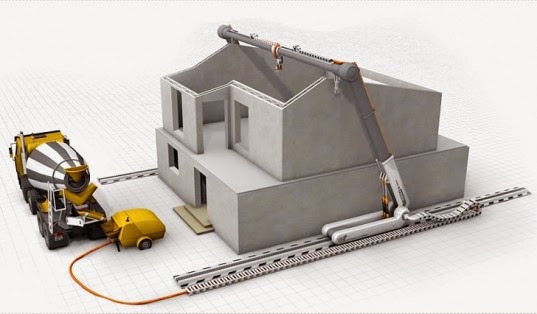
Professor Behrokh Khoshnevis’ revolutionary robot can 3D print an entire 2,500-square-foot home in just 24 hours. The technology was first developed at the University of Southern California, and it has since caught the eye of NASA and major building firms. The printer is based on the principles of contour crafting—a process that 3D prints large-scale objects layer by layer.
The 3D printer has two crane-like arms and a crossbeam which carries the printhead. The entire machine runs along a set of tracks and can work on all parts of the house simultaneously. Professor Khoshnevis believes the printer can build an entire two-story house in just under a day. For the printer to do its work, the space around the site needs to be prepared and the foundation in place. Additional work is required when it comes to window head jambs and metal ceiling, which can be done either by hand or by cranes. The rest of the process is almost completely automated.
The innovative technology of 3D printing large structures could revolutionize the building industry and help meet the growing demand of housing in city centers. Meanwhile, NASA has given Khoshnevis a grant to experiment with lunar structures and buildings that could potentially be erected on other Earth-like planets.
Via Dvice
Related Posts:
Giant 3D printer could build homes in under a day � RT USA
This 3D Printer, Capable Of Building A House In A Day, Could ...
How a 3D printer could build your next house in 24 hours | News ...
mylink


